
Your cart is empty
Bio-Based Wax Alternatives to Carnauba for High-Performance Inks and Coatings
Dr. Vamsi Vadhri, Monical Dahl, Shamrock Technologies, USA
Abstract
Carnauba wax is widely used in inks and coatings due to its exceptional hardness, gloss, slip, and abrasion resistance, as well as its natural and microplastic-free profile. However, its reliance on a single geographic source in Brazil introduces significant cost volatility and supply-chain risk for formulators. In response, Shamrock is developing sustainable, fluorine-free wax alternatives designed to replicate the performance of carnauba wax while improving long-term supply resilience.
This work focuses on bio-based waxes, particularly rice bran wax, a renewable byproduct of rice processing with established regulatory acceptance. Through advanced wax modification strategies, including wax alloying, electron-beam irradiation, controlled thermal conditioning, and particle engineering—key performance attributes such as abrasion resistance, gloss, and slip are systematically tuned. These approaches enable the development of a portfolio of PFAS-free, microplastic-free wax additives suitable for demanding ink and coating applications.
1. Introduction
Waxes are essential functional additives in inks and coatings, influencing surface and bulk properties including abrasion and scratch resistance, coefficient of friction (COF), blocking behavior, gloss, haze, printability, and durability1. These performance attributes are governed by wax chemistry, crystallinity, molecular architecture, size and particle morphology.
Among natural waxes, carnauba wax (CW) has long served as the industry performance standard due to its high melting point, high modulus, and highly crystalline ester network. Consequently, CW is widely employed in high-demand applications such as coil and can coatings, overprint varnishes, and industrial printing inks2,3.
However, increasing supply-chain risk, price volatility, and sustainability constraints have accelerated interest in alternative wax technologies. CW is sourced exclusively from Copernicia prunifera, native to northeastern Brazil, primarily within the Caatinga and Cerrado biomes—ecosystems subject to drought stress, land degradation, and biodiversity loss4. Concurrently, regulatory and market pressures are driving the elimination of fluorinated additives and intentionally added microplastics, increasing demand for renewable, compliant wax systems.
These factors highlight the need for high-performance wax additives that combine carnauba-like functionality with improved supply resilience and sustainability. This study addresses this challenge through the development of modified rice bran wax (RBW) systems.
2. Background
2.1 Carnauba Wax
Carnauba wax is extracted from the leaves of Copernicia prunifera and consists predominantly of long-chain aliphatic esters, with minor fractions of fatty alcohols, fatty acids, hydrocarbons, and resins5. The ester fraction is dominated by C26–C30 species, including hydroxycinnamic acid diesters and ω-hydroxycarboxylic acid derivatives, which assemble into a highly ordered crystalline structure.
Key properties of CW include:
- Melting point: 82–86 °C
- Very high crystallinity
- High modulus and hardness
- Low surface energy
- Excellent abrasion resistance
This dense crystalline ester network enables the formation of durable, low-friction surface layers, underpinning CW’s superior performance in wear-resistant coating systems. CW is also approved for food contact applications, including use as a glazing agent (E903)7.
2.2 Rice Bran Wax
Rice bran wax (RBW) is recovered as a byproduct of rice bran oil refining, representing approximately 2–5% of the oil fraction. As a globally distributed agricultural byproduct, RBW offers advantages in availability and sustainability without competition with food supply.
RBW consists primarily of saturated long-chain monoesters (C46–C60), formed from C22–C26 fatty acids and C26–C30 fatty alcohols8,9. Major constituents include myricyl cerotate, ceryl cerotate, and related esters, with minor amounts of higher wax acids, alcohols, squalene, and phospholipids. The ester distribution in RBW is dominated by a small number of high-carbon esters, resulting in a relatively narrow molecular weight distribution compared to many other vegetable waxes6.
Intrinsic properties of RBW include:
- Melting point: 78–82 °C
- Very high ester content
- High crystallinity
- High oil-binding capacity
- Non-tacky character
RBW exhibits low iodine values, reflecting a highly saturated structure with limited oxidative reactivity, which is advantageous for thermal and oxidative stability in formulated systems.
These characteristics position RBW as a close structural and thermal analog to CW, with established use across cosmetic, food, pharmaceutical, and specialty industrial applications10-12.
2.3 Comparative Properties
| Property | Carnauba Wax | Rice Bran Wax |
| Source | Single region (Brazil) | Global byproduct |
| Melting point (°C) | 82–86 | 78–82 |
| Ester content | Very high | Very high |
| Crystallinity | Very high | High |
| Hardness | Very high | Moderate–high |
| Abrasion resistance | High | Moderate (unmodified) |
| COF reduction | High | Moderate |
| Oil binding | Moderate | High |
| Food Contact Approval | Approved | Approved |
2.4 The Case for Tailored RBW Modification
Despite strong chemical and thermal similarity to CW, unmodified RBW typically exhibits inferior surface durability, reduced slip performance, increased particle agglomeration, haze formation, and inconsistent dispersion behavior in coating systems. These deficiencies arise from differences in crystallite size, crystal habit, molecular packing, and interfacial interactions.
Measured unsaponifiable fractions and residual hydroxyl functionality in RBW further influence interfacial behavior and crystallization kinetics, contributing to performance gaps relative to CW in demanding surface applications6.
Accordingly, targeted modification of RBW microstructure and interfacial properties is required to achieve carnauba-equivalent performance in high-demand ink and coating applications.
3. Experimental Approach and Development Strategy
To enable rice bran wax to meet or exceed the performance characteristics of carnauba wax, Shamrock applied a suite of advanced modification techniques designed to tailor wax structure and interfacial behavior while preserving inherent sustainability advantages.
3.1 Wax Alloying (Waxallurgy)
Waxallurgy refers to the intentional combination of two or more waxes to create alloyed structures with synergistic performance benefits. Rather than simple physical blends, this approach involves controlled co-melting or co-processing to promote intimate mixing and engineered crystallization behavior. By manipulating crystal size, shape, and distribution, wax alloying enables optimization of hardness, slip, and abrasion resistance beyond what is achievable with individual wax components.
3.2 Thermal Conditioning and Particle Engineering
Controlled thermal conditioning was used to influence wax crystallization kinetics and phase behavior, while particle engineering techniques were applied to optimize particle size distribution and morphology. These steps improve dispersion quality, reduce agglomeration, and minimize haze formation in formulated systems. Together, these approaches enable consistent incorporation of modified waxes into inks and coatings while maintaining clarity and surface performance.
3.3 Electron Beam Irradiation
Electron beam (e-beam) irradiation was employed as a physical, additive-free modification technique to induce controlled molecular rearrangements within ester-based wax structures. Ionizing radiation generates reactive radicals through ionization and excitation processes, enabling reactions such as limited branching, crosslinking, or chain scission13,14. The dominant modification pathway depends on molecular mobility, crystallinity, and structural weak points within the wax. In crystalline materials such as rice bran wax, careful control of processing state and irradiation conditions is required to promote structural reinforcement rather than degradation. When appropriately managed, e-beam treatment provides a viable method for tuning hardness, abrasion resistance, and thermal stability. The process leaves no residual radiation and is widely used in industrial polymer modification applications.
Modified rice bran waxes produced through these combined strategies were prepared for evaluation in representative applications, including coil coating, can coating, and overprint varnish, with performance benchmarked against conventional carnauba wax products.
4 Experimental methods
4.1 Materials
For these tests, industrial standard grades of the following materials were used: Rice Bran wax, Non-Polyolefin Synthetic wax, Carnauba wax, Amide wax, Polyolefin waxes, and Oxidized Polyolefin waxes.
4.2 Wax Processing Methods
Wax modification was carried out using a combination of three different approaches: melt blending, jet milling, and electron beam irradiation. These methods were selected to modify wax morphology, particle size distribution, and physicochemical properties without altering the base wax chemistry.
Melt blending was performed by heating the wax above its melting point and blending it with selected modifiers under controlled thermal and shear conditions to ensure homogeneous incorporation. The molten blend was subsequently cooled and solidified prior to downstream processing.
Jet milling was used as a physical modification technique to reduce particle size and alter particle morphology. Solid wax materials were micronized using high-velocity pressurized air, producing fine powders with narrow particle size distributions and minimal thermal degradation.
Irradiation was conducted using an electron accelerator at Shamrock Technologies. Pre-dried powder was loaded into circular molds measuring 2.5 cm in diameter and 0.2 cm in height. Following chamber closure, the system was purged with nitrogen to displace ambient moisture and oxygen. A continuous nitrogen flush was maintained throughout the procedure. The irradiation chamber was held constant at constant temperature for the prescribed duration. After treatment, samples were cooled to room temperature under a sustained nitrogen atmosphere.
4.3 Coating Formulation and Application
For coil coating evaluations, test materials were incorporated into solvent-based polyester coil coating at a loading level of 1.5 wt%. Coatings were applied to test panels using a #30 wire-wound drawdown bar and cured at 300 °C for 1 minute.
For can coating evaluations, test materials were similarly incorporated in water-based polyester can coatingwith a 1.5 wt% additive loading. Coatings were applied using a #10 wire-wound drawdown bar and cured at 210 °C for 2 minutes.
For overprint varnish, test materials were incorporated at 2.0 wt% additive loading in water-based acrylic coating. Coatings were applied using a #13 wire-wound drawdown bar and cured at ambient conditions.
4.4 Test Methods
Abrasion resistance was evaluated using a Taber Abraser equipped with CS-10 abrasive wheels. A load of 500 g was applied to each arm, and samples were subjected to 1,000 abrasion cycles. The abrasive wheels were resurfaced every 250 cycles using S-11 abrasive paper.
Scratch resistance was measured using a TQC Sheen SH075 scratch tester in accordance with the instrument’s standard operating procedure.
The coefficient of friction (COF) was determined using an Altek 9505C Mobility/Lubricity Testing Unit. Measurements were conducted using a 2 kg sled moving at a constant speed of 20 in/min across the coated surface.
Gloss measurements were performed using a BYK micro-TRI-gloss meter at the appropriate measurement angles for the coating system under evaluation.
5. Results
5.1 Coil Coating Applications
Modified rice bran wax (RBW) was evaluated as a direct replacement for carnauba wax in four distinct coil coating formulations (Formulations A–D). In each case, the original carnauba-based formulation—containing various combinations of Non-Polyolefin Synthetic wax (NPS), Amide wax, Polyolefin wax (PO), and Oxidized Polyolefin wax (OPO)—was reformulated by substituting carnauba wax with RBW while maintaining all other components and additive levels constant.
| Formula A | Formula B | Formula C | Formula D |
| NPS/Carnauba | Amide wax/Carnauba/PO | Amide wax/Carnauba | PO/Carnauba/OPO |
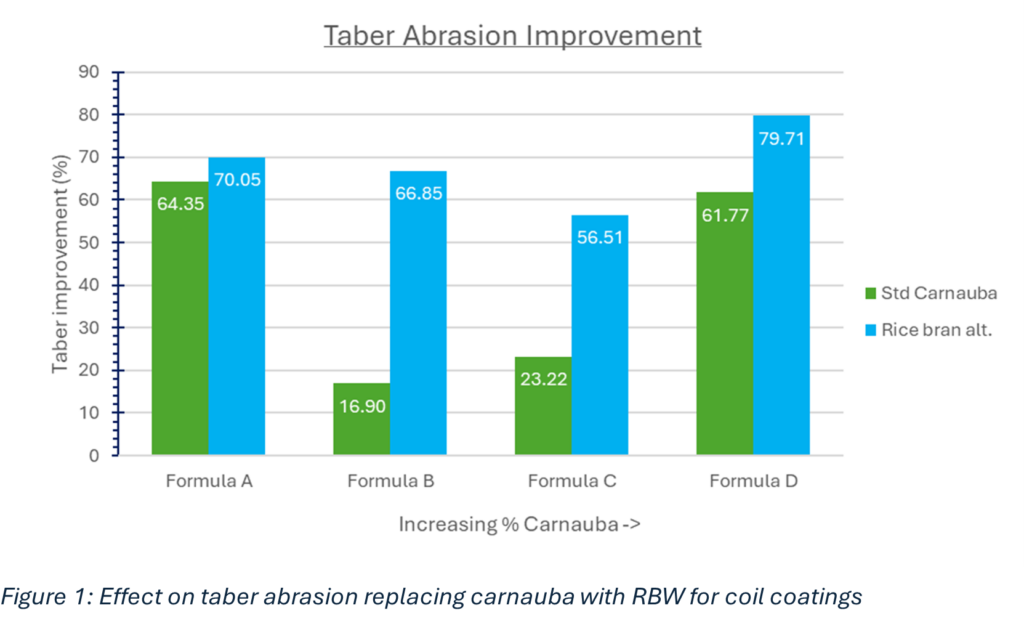
Taber Abrasion: RBW substitution demonstrated slightly or significantly improved performance compared to carnauba across all formulations (Figure 1). This indicates that the modification strategies successfully enhanced the inherent abrasion resistance of rice bran wax to carnauba levels.
Synergistic Effects with Amide Wax: Formulations containing Amide wax showed particularly significant improvements in abrasion resistance when RBW was substituted for carnauba. The margin of improvement was substantially higher than in other formulations, suggesting a synergistic interaction between modified RBW and Amide wax that may enable superior product performance.
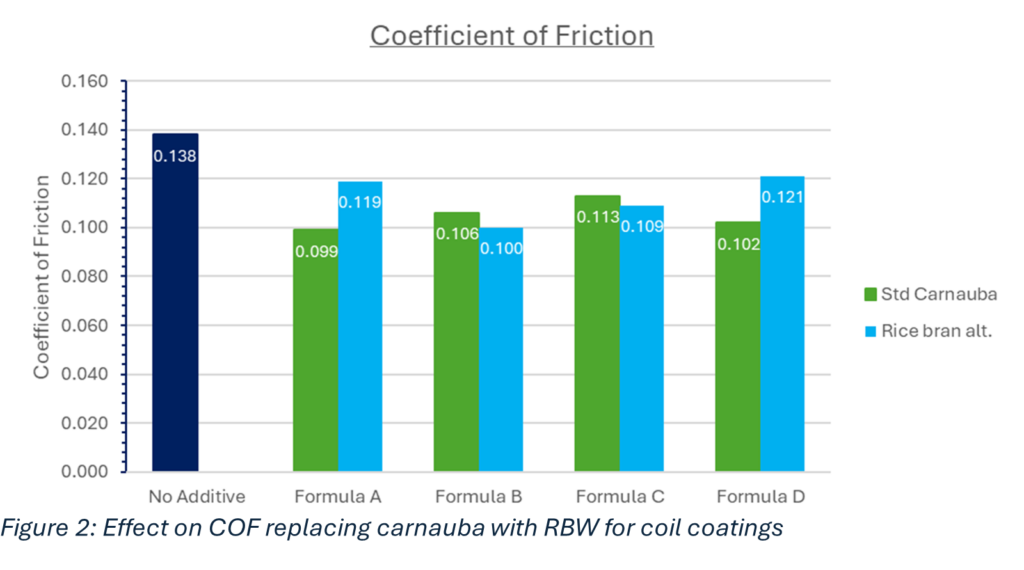
Coefficient of Friction (COF): COF performance showed formulation-dependent variation rather than consistent improvement or reduction from RBW substitution (Figure 2). Notably, COF improved when RBW was combined with Amide wax-containing formulas (Formulas B and C), while it was slightly worse in formulations without Amide wax. This indicates that COF is more dependent on the combination with other formulation components than on the simple substitution of carnauba with RBW.
5.2 Water-based Can Coating Applications
Similar to the coil coatings study above, five water-based can coating formulations (Formulas 1, 2, 3, 4, 5) were evaluated with RBW substitution for carnauba wax.
| Formula 1 | Formula 2 | Formula 3 | Formula 4 | Formula 5 |
| Amide wax/ Carnauba/PO | Amide wax/ Carnauba | Carnauba/NPS/ OPO | PO/Carnauba/ OPO | Carnauba/ NPS |

Taber Abrasion Resistance: All RBW-substituted formulas showed significant improvements in Taber abrasion resistance compared to their carnauba-based counterparts (Figure 3). While the magnitude of improvement varied by formulation, all demonstrated very good Taber abrasion resistance, indicating RBW’s superior performance in this critical parameter for can coatings.

COF: COF showed modest reductions in performance with RBW substitution (Figure 4). Although not dramatic, these reductions were statistically significant. The contrast between the dramatic Taber abrasion improvements and the slight reductions in gloss/COF suggests different structure-property relationships govern these performance characteristics.
5.3 Irradiated RBW in Water-based Overprint Varnish (OPV)
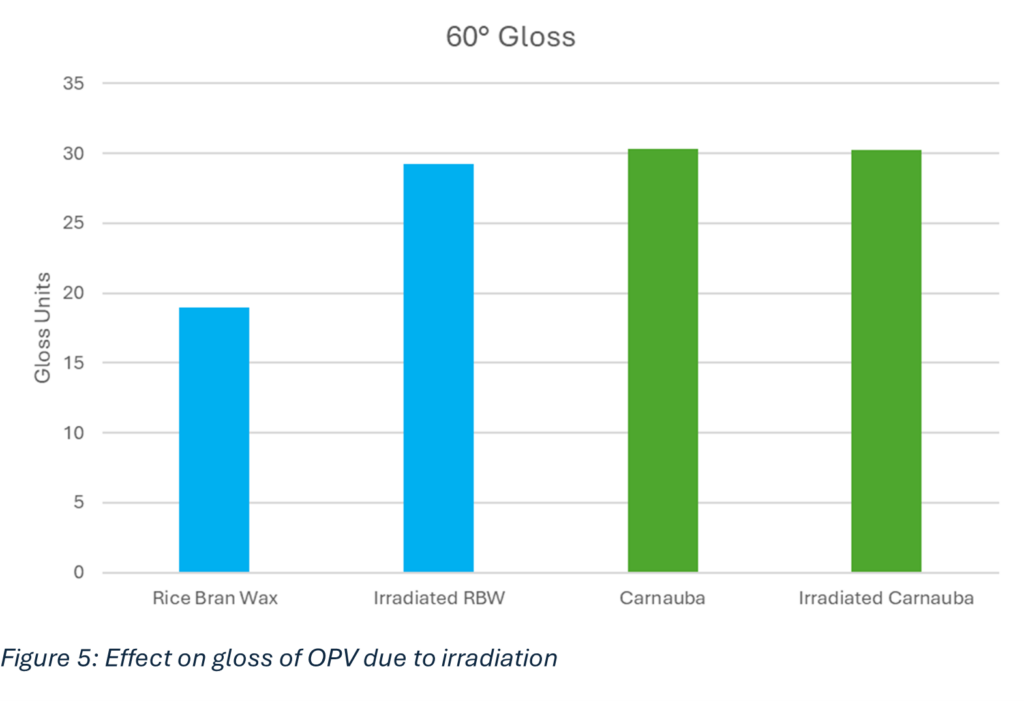
Gloss improvement through Irradiation: The effect of electron beam (e-beam) irradiation on gloss performance was evaluated using OPV drawdowns prepared with rice bran wax (RBW) and carnauba wax as additives, following the procedure described in the Experimental Section. Initial measurements indicated that OPV formulations containing unmodified RBW exhibited significantly lower gloss compared to those containing carnauba wax, confirming a clear performance gap between the two materials in their native forms.
Upon subjecting both waxes to identical e-beam irradiation conditions prior to incorporation into the OPV system, a marked increase in gloss was observed for RBW-containing formulations, with gloss values rising to levels comparable to those achieved with carnauba wax (Figure 5). In contrast, irradiation of carnauba wax resulted in no measurable change in gloss performance under the same conditions.
This differential response suggests that the irradiation-induced modification is specific to the molecular structure and/or crystalline morphology of RBW. The results demonstrate that e-beam treatment is an effective and targeted strategy for addressing gloss deficiencies in RBW without altering the performance of inherently high-gloss waxes such as carnauba. The underlying mechanisms responsible for the observed gloss enhancement—potentially involving changes in molecular weight distribution, branching, crystallinity, or surface morphology—are currently under investigation using advanced analytical techniques.
6. Conclusions
The systematic evaluation of modified rice bran wax across multiple coating applications demonstrates its viability as a high-performance, sustainable alternative to carnauba wax. Key conclusions include:
1. Modified RBW achieves equivalent or superior performance to carnauba wax in critical parameters, particularly abrasion resistance. In coil coatings, RBW matches or exceeds carnauba’s performance, especially when combined with Amide wax additives. In water-based can coatings, RBW demonstrates significantly improved Taber abrasion resistance across all tested formulations.
2. The performance of RBW is influenced by formulation components, with particularly strong synergies observed with Amide wax additives. This suggests that optimal implementation of RBW alternatives may involve co-engineering of both the wax modification and the formulation composition.
3. Electron beam irradiation effectively addresses specific performance gaps in RBW, such as gloss in OPV applications, without affecting carnauba wax. This demonstrates the precision of advanced modification techniques in tuning wax properties for specific applications.
4. Unlike carnauba wax, which is sourced from a single geographic region, rice bran wax is globally available as a byproduct of rice processing. This distributed supply chain offers significant advantages in terms of cost stability, supply security, and sustainability.
5. Modified RBW systems are inherently PFAS-free, microplastic-free, and derived from renewable agricultural byproducts. This aligns with regulatory trends and market demands for more sustainable coating and ink formulations.
6. The consistent performance of modified RBW across diverse applications—coil coatings, can coatings, and OPVs—supports its commercial adoption as a drop-in or near-drop-in replacement for carnauba wax in many formulations.
The development of high-performance, modified rice bran wax represents a significant advancement in sustainable wax technology. By combining global availability with tunable performance characteristics, these materials address both the technical requirements of demanding applications and the strategic need for supply chain resilience. Future work will focus on expanding the application scope, optimizing formulation guidelines, and further refining modification techniques to unlock additional performance benefits.
7. References
1. Krendlinger, Ernst & Wolfmeier, Uwehelmut. (2022). Natural and Synthetic Waxes: Origin, Production, Technology and Applications.
2. T.H. Shellhammer, T.R. Rumsey, J.M. Krochta, Viscoelastic properties of edible lipids, J.
Food Eng. 33 (1997) 305-320.
3. Tinto WF, Elufioye, TO, Roach J. Waxes In Pharmacognosy – Fundamentals, Applications
and Strategies. Badal S, Delgoda R (Ed.) 2017, 443−455, Elsevier
4. C. A. S. de Freitas, P. H. M. de Sousa, D. J. Soares, J. Y. G. da Silva, S. R. Benjamin and M. I. F. Guedes, Food Chem., 2019, 291, 38–48
5. E. Krendlinger, U. Wolfmeier, H. Schmidt, F.-L. Heinrichs, G. Michalczyk, W. Payer, W. Dietsche, K. Boehlke, G. Hohner and J. Wildgruber, “Waxes”, Ullmann’s Encyclopedia of Industrial Chemistry, Wiley-VCH, Weinheim, 2015, pp. 1–63
6. A. D. Maru, R. K. Surawase and P. V. Bodhe, Int. J. Pharm. Phytopharmacol. Res., 2012, 1, 203.
7. EFSA Panel on Food Additives and Nutrient Sources added to Food (ANS), EFSA J., 2012, 10(10), 2880
8. Dassanayake, L. S. K., Kodali, D. R., Ueno, S., & Sato, K. (2009). JAOCS, Journal of the American Oil Chemists’ Society, 86(12), 1163–1173.
9. S. H. Yoon and J. S. Rhee, J. Am. Oil Chem. Soc., 1982, 59, 561–563
10. P. Abhirami, N. Modupalli and V. Natarajan, J. Food Process Preserv., 2020, 44, e14989
11. F. T. Orthoefer, Rice Bran Oil, in Bailey’s Industrial Oil and Fat Products, ed. F. Shahidi, John Wiley & Sons, 6th edn, 2005, vol. 2, p. 465.
12. O. S. Kittipongpatana, K. Trisopon, P. Wattanaarsakit and N. Kittipongpatana, Pharmaceutics, 2024, 16, 428.
13. Krieg, D.; Sergeieva, O.; Jungkind, S.; Rennert, M.; Nase, M. J. Appl. Polym. Sci. 2023, 140, 14. Krieg, D.; Müller, M.T.; Boldt, R.; Rennert, M.; Stommel, M. Polymers 2023, 15, 4072.